
Wildlife Photography Tip: Look Beyond the Animal

Published by Gabriel in 2. Photography hint and ideas · Saturday 11 Jul 2026 · 4 minutes
Tags: photography, ideas, learning
Tags: photography, ideas, learning
A comprehensive guide for obtaining the best pictures
When we see a lion, elephant, leopard or colourful bird, our first instinct is to concentrate entirely on the animal. We think about the eyes, focus, exposure and the right moment to press the shutter.
Later, however, we may discover that something is missing from the photograph.
Very often, the problem is not the animal. It is everything around it.
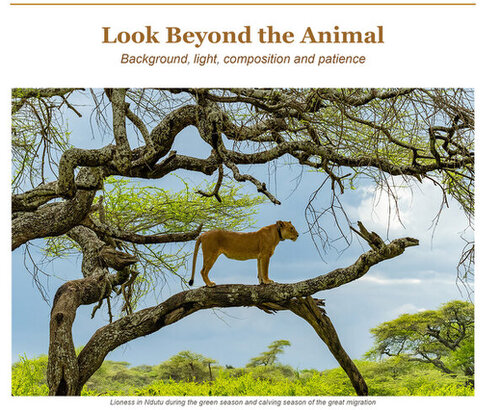
A distracting background, an unfortunate horizon, bright patches, branches or too many competing elements can weaken an otherwise excellent wildlife photograph. Learning to examine the complete frame can make a considerable difference.
Highlights from the Guide
Check what sits behind the animal
Before I press the shutter, I look for branches crossing the animal’s outline, bright patches in the grass and vehicles in the distance. Then I scan the edges of the frame. A sliver of another animal or a branch entering from a corner is easy to miss when I’m watching the eye.
A small change in position can help. While photographing storks in a tree, we moved forward a little and lined up a cloud behind several of the birds. Their outlines became clearer. When the guide can reposition without disturbing the animals, I look through the viewfinder again to see what the move has done to the background.
Leave room for the landscape
When an elephant walks beneath a baobab, I consider keeping the whole tree in the frame. The elephant gives the tree scale, and the tree shows where the encounter happened. I look at the horizon and leave space in the direction the animal is moving. If the surroundings help tell the story, I keep them in the composition.
Watch what the light is doing
Backlight can make dust visible as a herd crosses a dry plain. A cloud passing over the sun can soften deep shadows on an animal’s face. If the light is changing, I watch where it falls across the frame. Sometimes the photograph comes together when the animal takes a few steps into an area where its outline is easier to see.
Wait for a specific moment
When a scene has potential, I look for one change that would improve the frame. A lion might lift its head above the grass, a zebra might step clear of the herd, or a bird might move to an open perch. Having something specific to watch for helps me stay ready while the scene unfolds.
Compare your frames after the drive
During a sighting, I keep playback brief so I can follow the animal. Later, I compare two frames from the same encounter and ask what changed. Did the background get cleaner? Did the light reveal more detail? Did the wider composition give the animal a stronger sense of place? The answer gives me something concrete to look for on the next drive.
A strong wildlife photograph should do more than record an animal. It should guide the viewer’s attention and communicate something about the light, landscape, behaviour and atmosphere of the encounter.
Before pressing the shutter, take a moment to look beyond the subject. Examine the entire frame and ask whether every visible element supports the photograph.
Sometimes moving only a few metres, lowering the camera or waiting a little longer can completely transform the final image.
## Download the Complete Article
Download the complete guide for detailed explanations, practical examples and a field checklist that you can use during your next wildlife photography experience.